

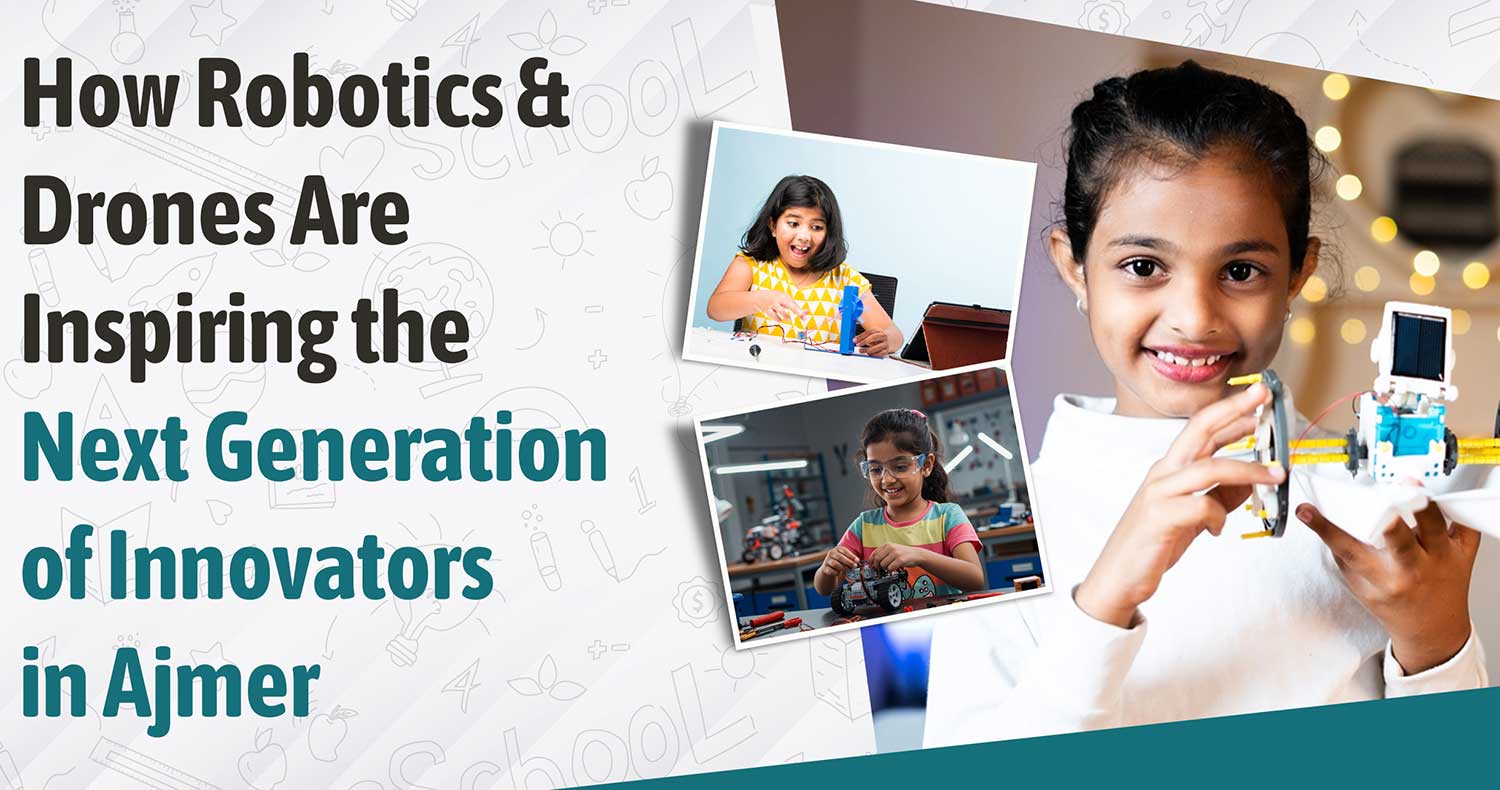
Consider a classroom where students aren’t just learning history but are making robots, programming drones, writing code for the robots or drones to carry out tasks, and using problem-solving skills to address real-world issues. Sounds futuristic? Not anymore. Around the world – and in cities like Ajmer now, too – the classroom is changing with the addition of robotics in education and other high-tech tools that help prepare students for a future world.
For most children, the magic of robots starts as play – pushing a button and watching a machine move, watching lights blink in response. But what lies beneath such play is something even more potent: curiosity. When kids are tinkering with robots, they don’t just learn how to put together parts; they also learn problem-solving, logical thinking, and creativity.
This transition from passive learning to active engagement is why the introduction of coding and robotics for kids has been – and continues to be – so innovative. Instead of learning what makes technology work, students find out for themselves – bit by bit, code by code. This is experiential learning at its best.
While robotics offers children the tools to build, drones give them the wings to explore. Drones are no longer reserved for science labs or research centres; they are being brought into classrooms and used as an educational tool to teach everything from geography to algebra and even environmental studies.
Think of a classroom in Ajmer where students are studying river systems while not just looking at maps but flying drones to record aerial views of the nearby landscapes. Suddenly, geography is not just lines on a page; it becomes a more immersive, interactive experience. Drones incorporate the theory and practice of physics, engineering, and information in aerodynamics, design, and data management.
For parents today, one of the biggest challenges is figuring out how to make learning fun for kids growing up surrounded by screens. As emerging technologies in education, robotics and drones epitomize that. They blend fun and functionality, the very thing that will keep the students inquiring.
It’s no longer just about assembling a machine or moving a gadget – it’s about the joy of watching their own ideas spring to life. When a kid codes a robot to pick something up or programs a drone to take a picture, they immediately see the results of their imagination and labor.
You’ve probably heard someone say – or said yourself – that the jobs our children will do haven’t even been thought of yet. That may be daunting, but it’s also inspiring. Robots and drones are among the tools getting students ready for an uncertain future.
They teach more than just professional skills. Children learn teamwork, critical thinking, patience, and resilience, along with programming and design. These are life skills, as well as educational ones. And with STEM education in schools, students are preparing to solve problems in domains as diverse as healthcare, agriculture, space research, and urban planning.
When we think about robotics in education, it is tempting to get caught up in the gadgets. But the real value lies in the mentality it builds. A child who learns to correct a formatting error does not only correct a technical glitch – they also learn patience. They don’t just build a machine when a group of students together programs a robot – they learn to collaborate and to lead.
These are invaluable lessons in a world where the ability to adapt is key.
Here’s what matters: Innovation is not limited to schools. Parents have this enormous ability to foster curiosity at home. Encouraging kids to tinker, to ask questions, and to celebrate the small victories, whether in robots or drones, can make a huge difference.
It is like planting seeds. The more we water curiosity at home, the more it thrives in school.
If today’s kids are being taught robotics and drones at a young age, just think what they will be able to do as adults. The future of technology in education lies not in rote learning, but in creating environments where experimentation, exploration, and creativity thrive.
Education isn’t about rote learning of formulas anymore; it’s about learning to think, question, and create. And that is precisely what robotics and drones allow.
Even in smaller cities, such as Ajmer, seizing these opportunities is heartening. Schools are incorporating robotics labs, drone workshops, and coding classes, ensuring that children here aren’t left out of the global wave of innovation.
For a parent, it’s a sign of how education is progressing – preparing children not simply to be responsive to the future, but to lead it.
Ultimately, it’s not just about building robots or drones – it’s about building thinkers, dreamers, and doers. The young inventors of Ajmer are proof that when it comes to ideas, nothing’s impossible with the right guidance, tools, and support.
And if you are wondering where such opportunities are blooming, Satguru International School, Ajmer, is one place setting the precedent for this. By integrating digital tools with holistic learning, they’re not just keeping students up with the world but a step ahead as well.