

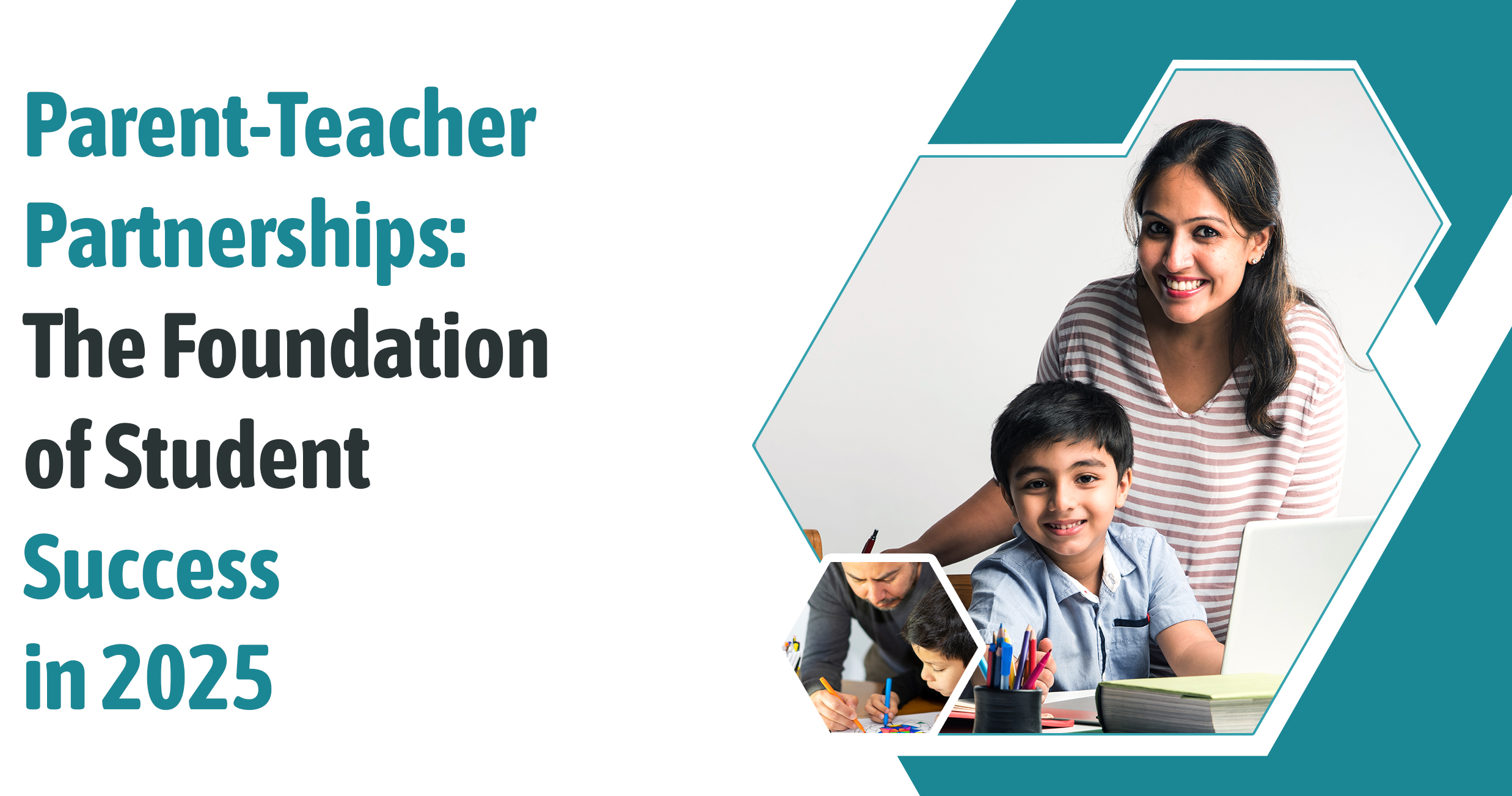
If you are a parent in 2025, you know education looks very different from when you were in school. Classrooms now blend digital tools, flexible learning spaces, and global exposure. Yet, the one factor that has not changed is this: a child succeeds when parents and teachers work together. This makes parent-teacher communication utterly essential.
Let’s explore what that means for you and your child today.
Simply imagine that learning is a relay race. Teachers pass the baton of knowledge during school hours. Parents carry it forward at home. Without smooth passing, the race slows down.
Research from the OECD makes this very clear. Students with active parent teacher communication perform up to 30 percent better in core subjects. That is a significant number, and it should make us pause. It tells us that communication is not a formality. It is a performance driver.
Now, this does not always mean long meetings. Even short and regular exchanges create impact. A teacher shares a child’s classroom strengths. A parent explains how the child studies at home. Both pieces of information connect, and the child benefits.
Here is where most schools and families stop – passing information. But in 2025, the real strength lies in collaboration. Teacher-parent collaboration is about joint problem-solving. It is about saying, “How do we help this child together?”
Online portals and apps now make access simple. Homework, attendance, progress reports – all visible. Yet, the quality of collaboration comes from respect. Teachers bring expertise in instruction. Parents bring a deep understanding of personality and habits. Together, both sides create consistency. And consistency is what children trust most.
School events and activities often feel optional. Parents may think: “Does it really matter if I attend?” The evidence says yes, it matters a great deal.
According to the National Center for Education Statistics, children with engaged parents are twice as likely to score higher. This is not about talent. It is about the environment. When children see parents take an active role in school life, they feel proud. That pride fuels motivation. It reduces absenteeism. It even improves classroom behaviour.
So, engagement is not only about helping the school. It is also about shaping your child’s confidence.
Now, let us talk about home. The role of parents in student success is often underestimated. UNICEF studies show that children in supportive households show 25 percent higher resilience during academic stress.
This means your contribution is not limited to homework help. It includes setting routines, offering encouragement, and modelling good behaviour. For example, when your child sees you reading, planning, or managing responsibilities, they learn silently. These lessons shape habits for life.
So, how do you put this into action? Let us give you a consultant’s checklist:
Each of these steps builds trust. Over time, your child senses the alignment. They feel supported from both ends. That feeling is powerful.
Education in 2025 will keep changing. New tools, new subjects, new methods. But one truth will hold steady: parent teacher communication shapes student outcomes. When schools and families act as one, children thrive.
So here is the question we leave with you: what step will you take this year to strengthen your partnership with your child’s teachers?
The foundation of student success is not technology, not even curriculum. It is people working together for the child. That is the partnership worth investing in.
If you have concerns with your child’s growth and want a heartful discussion about how things can be improved, Satguru International School welcomes you for an open conversation!